.png)
Industry
Remittance Advice: The Missing Link Between Payment and Reconciliation
Learn what remittance advice contains, how it differs from a payment confirmation, and why structured data improves invoice matching.



For years, the hard part of building a B2B financial product was the integration layer. Reading and writing into accounting systems, ERPs, commerce platforms, and payment processors is what makes a fintech or bank’s product work in the real world. Mercury, PayPal, Airwallex, Payoneer, and 120 other fintechs and banks run on Rutter today for exactly that work, across 60+ accounting, ERP, commerce, and payments platforms.
That problem has not gone away. It is no longer the only thing that matters.
The next decade of B2B finance will not be won on API coverage. It will be won on where the financial product actually lives: a digital app for SMB customers, and natively inside the ERP for mid-market. The fintechs and banks that win it will be the ones who put their product where the customer already works.
If your product only works when the customer comes to you, you are losing the mid-market.
Every B2B fintech and bank is racing to own the Financial OS for their business customers. The Financial OS is the complete suite of products and workflows that lets a business run all its financial operations in one place: payments, lending, AP, AR, reconciliation, forecasting. None of it works without integrations into the systems of record those businesses already run on, meaning the platforms where authoritative financial data lives (QuickBooks and Xero for SMBs; NetSuite, Microsoft Dynamics, Sage Intacct, and SAP for mid-market).
This is why Mercury, PayPal, Airwallex, Payoneer, and 120 other fintechs and banks run on Rutter today. One unified API across 60+ accounting, ERP, commerce, and payments platforms. Read and write. That work is still the foundation.
But once every serious player has the integrations, integration alone stops being the moat. The next question is where the financial product actually lives.
The use cases look similar across segments. Get paid. Pay bills. Reconcile. Forecast. What changes is the environment the end user works in.
An SMB at Mercury opens a browser tab and logs in to a banking app. One bank, one product, one place. A clean digital experience is enough.
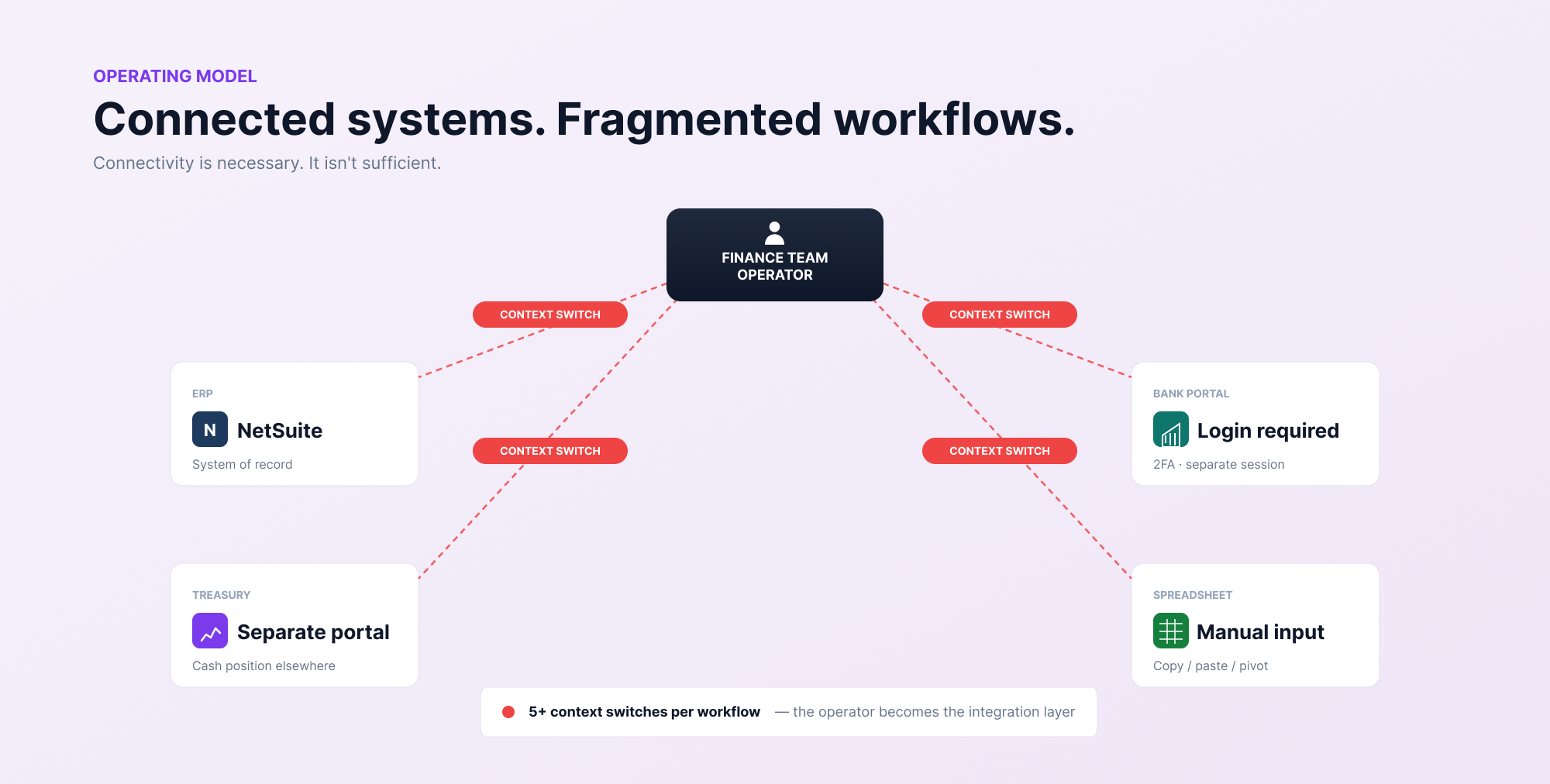
A mid-market customer does not work that way. They live in NetSuite, Microsoft Dynamics, or Sage Intacct. They have multiple banks. They route AP through their ERP. They are not going to leave their system of record for a separate banking portal, no matter how well designed it is.
If your product cannot show up inside the ERP, it does not exist for that customer.
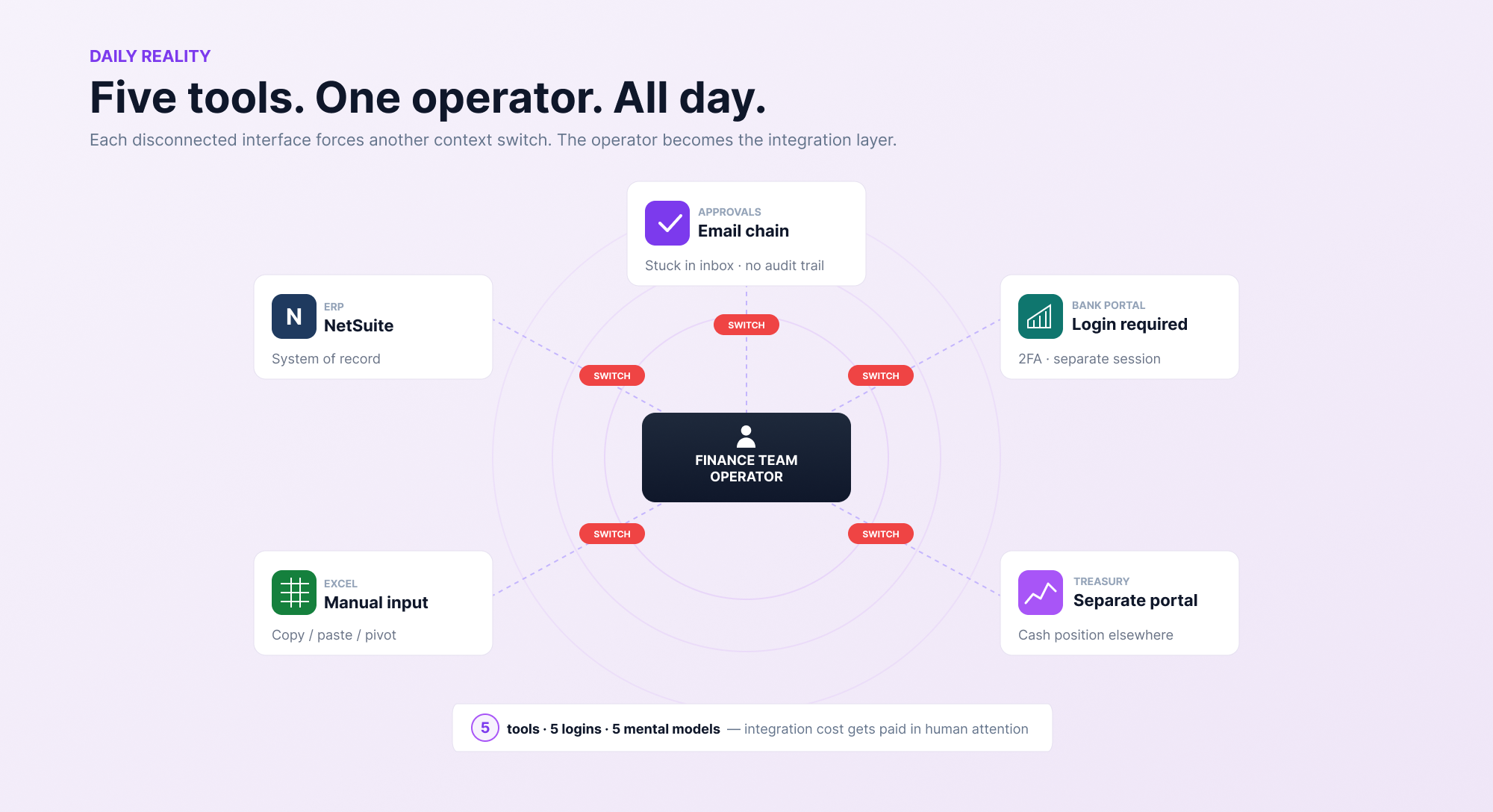
The product surface is. Most fintechs and banks underinvest here. They build the rails, build the underlying product, ship a portal, and expect the customer to come to it.
That worked for the first wave of SMB fintech. Mercury, Ramp, and Brex won SMB customers on a better web and mobile experience than incumbent banks could ship. It does not work in mid-market, because the customer is not coming to the portal. The portal has to come to them.
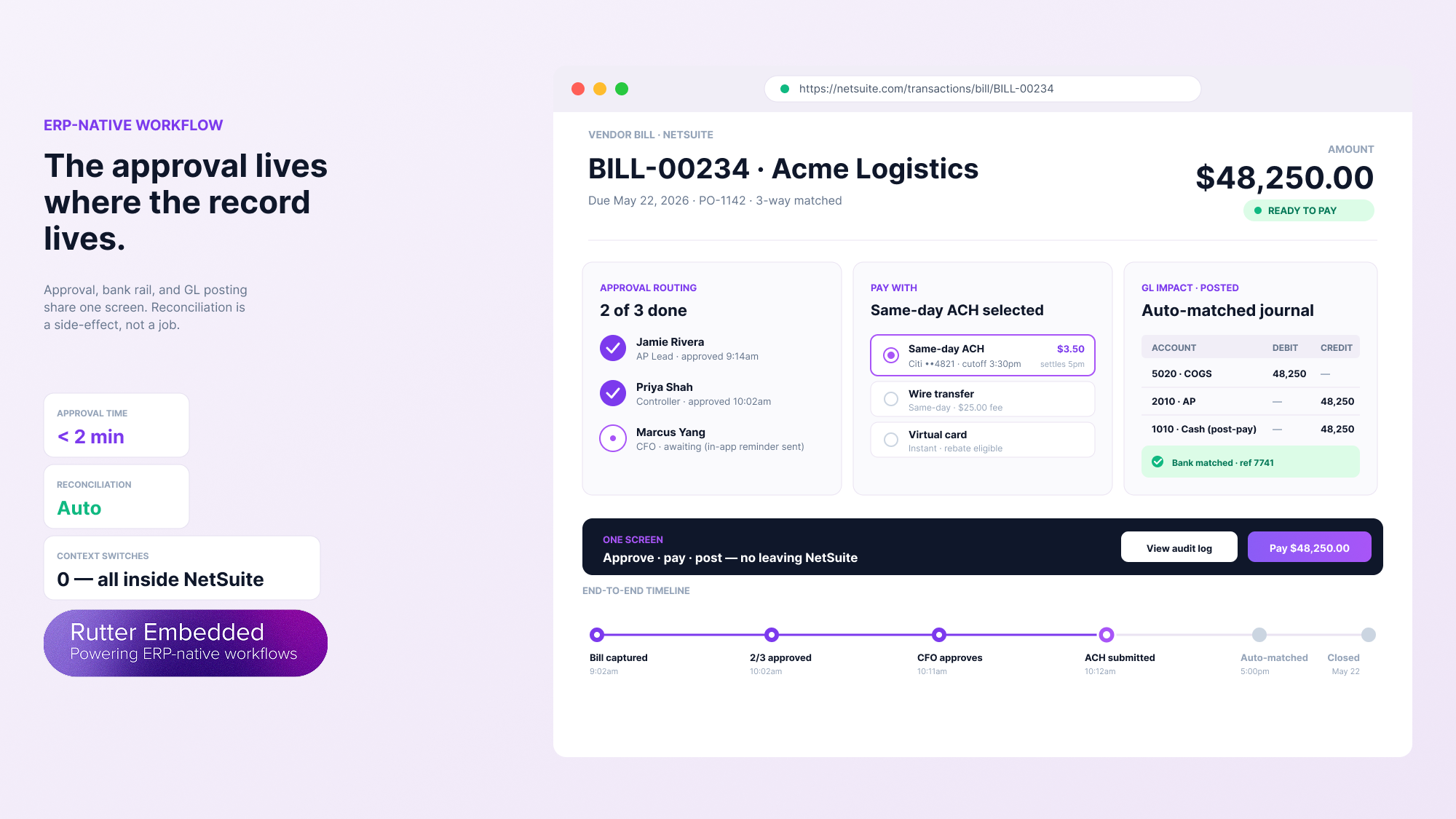
The product surface has to live in two places: a white-labeled digital experience for SMB customers who work in a browser, and a native ERP app for mid-market customers who do not. ERP-native means a financial product that lives inside the customer’s ERP, using the ERP’s own UI and workflows, instead of a separate portal the customer has to switch into.
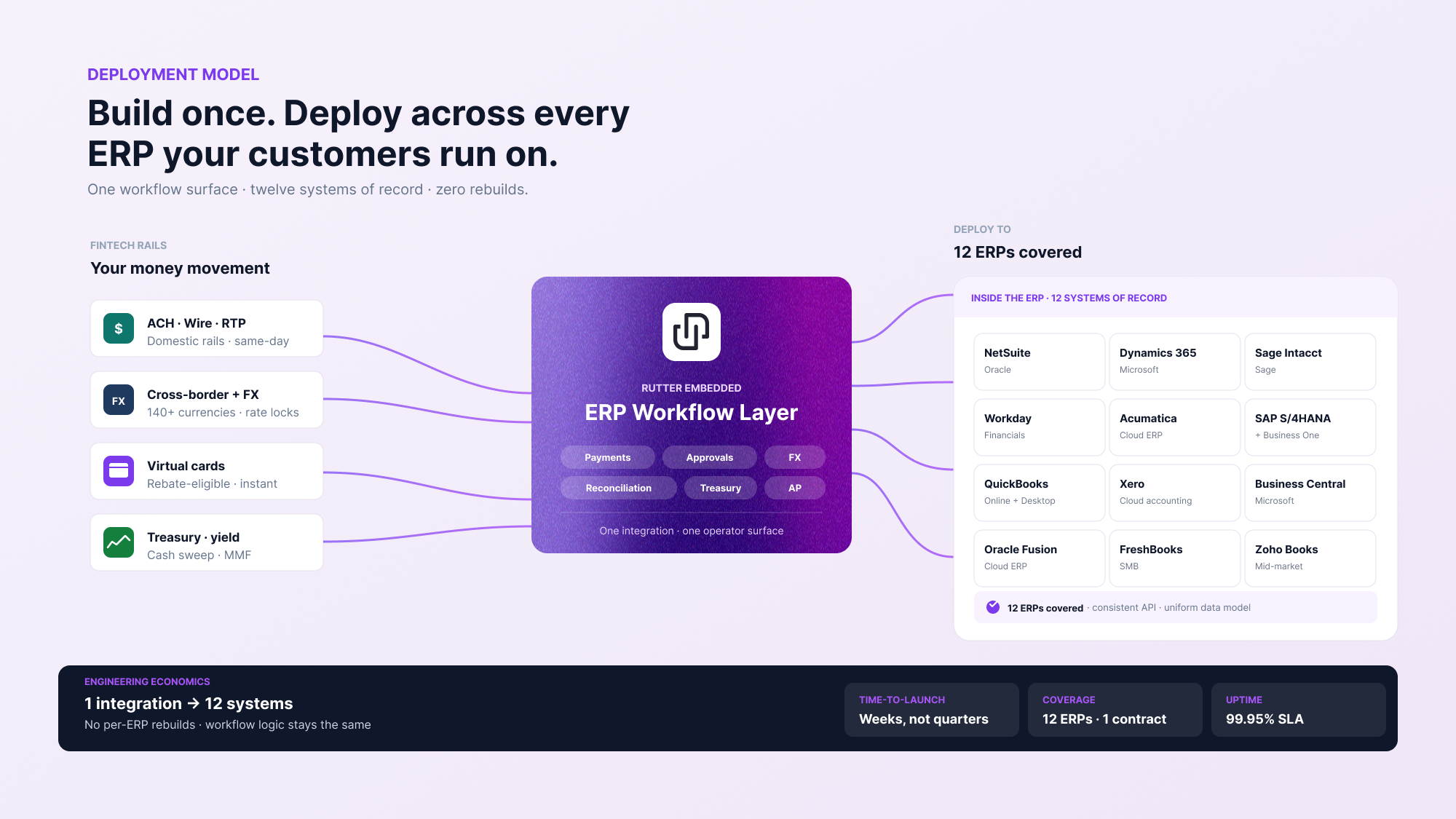
Building a real native ERP app is a different skill set from building a financial product. Every ERP has its own extension framework, permissions model, UI patterns, deployment requirements, and partnership process. NetSuite is not Microsoft Dynamics. Sage Intacct is not Workday. SAP S/4HANA is not Acumatica.
A typical internal build takes 12 months per ERP, requires constant maintenance, and demands ERP expertise most fintechs and banks do not have in house. Most teams that try this end up with one half-finished integration and a backlog they never ship.
Rutter Embedded ERP is a white-labeled financial app that runs natively inside the customer’s ERP, powered by Rutter’s unified API and your existing payment rails. The same integration infrastructure that powers Mercury, PayPal, Airwallex, and Payoneer also delivers a native embedded app inside 12 major ERPs, including NetSuite, Microsoft Dynamics, Sage Intacct, Workday, and SAP S/4HANA. Same integration infrastructure, two product surfaces.
Integrations are still the hard part. They are also no longer the whole part. The fintechs and banks that win the next decade will be the ones that put their financial product where the customer already works, whether that is a digital app or inside the ERP itself.
Rutter Embedded ERP puts your financial product natively inside NetSuite, Microsoft Dynamics, Sage Intacct, Workday, SAP, and seven more. Your rails, your brand, your customer relationships. Live in 4 weeks instead of the 12 months it takes to build internally.

The Financial OS is the complete suite of products and workflows that lets a business run all its financial operations in one place: payments, lending, AP, AR, reconciliation, forecasting, expense management. Every B2B fintech and bank is racing to own it for their business customers.
ERP-native means a financial product that lives inside the customer’s ERP (NetSuite, Microsoft Dynamics, Sage Intacct, Workday, SAP), using the ERP’s own UI and workflows. The customer never leaves their system of record to use the product.
Rutter Embedded ERP is a white-labeled financial app that runs natively inside the customer’s ERP, powered by Rutter’s unified API and the fintech or bank’s existing payment rails. It covers 12 major ERPs including NetSuite, Microsoft Dynamics, Sage Intacct, Workday, and SAP S/4HANA.
4 weeks, compared to the 12 months it takes to build a single ERP integration internally.
Each ERP has its own extension framework, permissions model, UI patterns, and partnership process. A typical internal build takes 12 months per ERP and requires constant maintenance. Most teams that try this end up with one half-finished integration and a backlog they never ship.
Mercury, PayPal, Airwallex, Payoneer, and 120+ other B2B fintechs and banks run on Rutter today across 60+ accounting, ERP, commerce, and payments platforms.

Building integrated products is hard. We can do that together. Let's chat.
.png)
.png)