

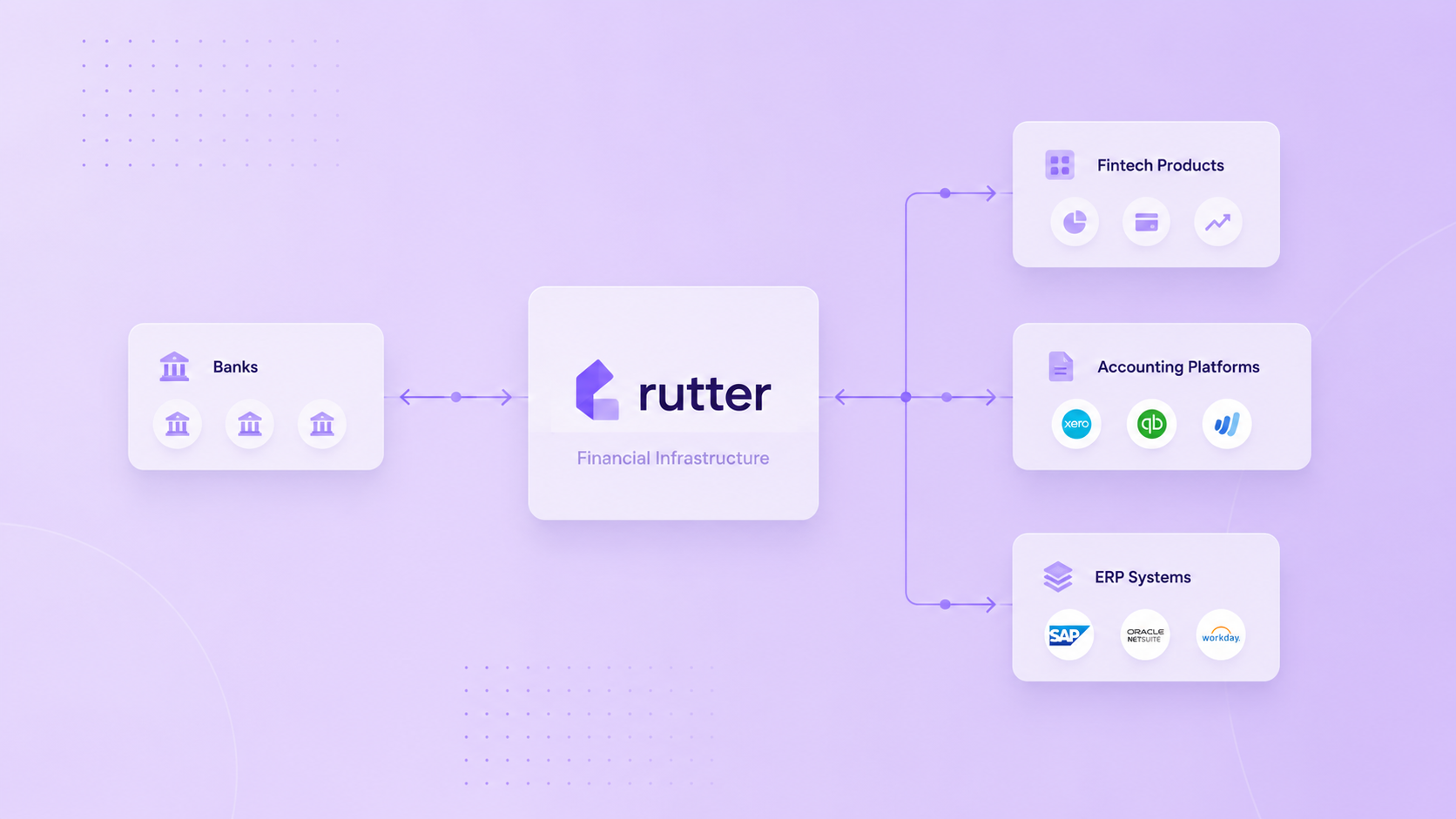
Read APIs vs. Workflow APIs: Why Fintech Products Need More Than Financial Data Access
Quick answer: A read API gives your product access to financial data. A workflow API helps your product complete a financial job across accounting, commerce, payments, and ERP systems without leaving your team to own every mapping rule, retry path, reconciliation issue, or platform-specific exception.
Fintech teams usually begin an integration project with a data-access question. Can we pull QuickBooks data through Rutter's Accounting API? Can we read Shopify orders through Rutter's Commerce API? Can we fetch Stripe payouts without forcing product teams to maintain each connector themselves? Those are reasonable first questions, but they rarely describe the product that needs to ship. A lender wants to underwrite a business. A card program wants transactions to land in accounting. An AP platform wants bills, vendors, approvals, payments, and reconciliation context to stay aligned.
At that point, the category changes. Data access matters, but the real problem becomes workflow execution. A financial product is only useful when the data is structured enough, fresh enough, and reliable enough to support a business process that customers already depend on.
What a read API does well
A read API is built around retrieval. It lets a product access records from a source system, usually through endpoints for objects such as accounts, customers, invoices, bills, orders, transactions, products, payouts, or financial statements. For many products, read access is the first unlock. It replaces CSV uploads, manual exports, and brittle customer workflows with a direct connection to the software a business already uses.
Read APIs are powerful for analytics, underwriting, dashboards, onboarding, verification, and reporting. A lender can pull revenue history from commerce platforms. A cash-flow product can read accounts receivable and accounts payable. A sales-tax or carbon-accounting product can analyze transactions without asking the customer to upload files every month.
OpenAPI-style documentation, OAuth-based access, and sandbox testing all make read integrations easier to start. Modern API standards are useful because they help humans and machines understand endpoints, authentication, objects, and request structure before the first line of product code reaches production.
Where read access stops being enough
Most fintech products eventually move past passive access. Reading an invoice is different from helping a customer create, approve, pay, sync, and reconcile that invoice. Reading card transactions is different from pushing those transactions into QuickBooks, Xero, or Sage in a way that supports clean bookkeeping. Reading commerce revenue is different from continuously monitoring the signals that change credit quality after a financing product is approved.
The gap appears whenever a product has to act on data rather than observe it. Action introduces state, timing, responsibility, and accounting consequences, especially in categories like bank feeds, supplier enablement, and ERP integration where the product has to support a complete workflow rather than a one-time data pull. Retry logic matters. Duplicate prevention matters. Mapping matters. User permissions matter. Tax treatment, currency handling, chart-of-accounts structure, and downstream reconciliation all start to matter.
What a workflow API actually needs to handle
A workflow API is not just a bigger read API. It is an integration layer designed around the job the product needs to complete. In financial software, that job usually crosses several systems and several types of users.
A bank-feed workflow may require account setup, institution listing, account mapping, transaction validation, sync status, platform ingestion status, duplicate prevention, and support visibility. An expense-sync workflow may require merchant data, card transactions, category mapping, vendor matching, and write behavior that finance teams can trust. An underwriting workflow may require commerce orders, payment transactions, accounting statements, refund history, customer concentration, and ongoing monitoring.
Each example starts with data access, but none end there. Workflows require enough infrastructure around the data to make the product operationally safe.
Workflow APIs are evaluated by failure behavior
A read API can look successful when a response returns. A workflow API is judged by what happens when the happy path breaks. Does the integration retry safely after a transient failure? Can support see why a connection stopped syncing? Are stale tokens distinguished from invalid permissions? Can duplicate transactions be prevented during queue replays? Can the customer understand which action they need to take?
Strong financial infrastructure does not pretend these issues disappear. It classifies them. It gives product teams a way to design around them. It gives implementation teams a way to debug them. It gives customers fewer moments where the product seems to be working while the books become harder to trust.
The four differences that matter most
1. Data objects vs. business objects
Read APIs expose records. Workflow APIs organize records around a business outcome. A transaction, vendor, account, invoice, payment, and statement are separate objects, but a finance team experiences them as one workflow when they reconcile books, close a month, or approve spend.
2. Access vs. accounting consequence
A GET request rarely changes the customer's source of truth. A write request can. Once a product creates an invoice, bill, journal entry, expense, or bank-feed transaction, poor mapping can create cleanup work for the finance team. Workflow APIs need to account for what happens after data lands.
3. Coverage breadth vs. workflow depth
Connector count is an incomplete evaluation metric. The more useful question is whether a provider supports the object coverage, endpoint depth, platform-specific behavior, and implementation guidance required for the workflow you are shipping. A provider can list QuickBooks and Xero while still missing a key object or write path that your product depends on.
4. Documentation vs. implementation support
Documentation helps teams start. Implementation support helps teams ship. Financial workflows often require business-process mapping before API mapping. The team needs to know which data objects matter, which edge cases are normal, which user decisions need to happen in-product, and which platform constraints cannot be coded around.
Examples by product category
Underwriting
A read API can pull financial statements, commerce orders, payouts, and transactions. A workflow API helps convert those objects into a repeatable underwriting pipeline: initial connection, historical sync, normalization, signal calculation, ongoing monitoring, and data freshness checks. The product is not just accessing data. It is making a decision that needs to be defensible.
Bank feeds
A read API can retrieve bank transactions. A bank-feed workflow pushes card or bank-account transactions into an accounting system so a customer can reconcile them. That workflow needs connection setup, account mapping, validation, ingestion status, freshness monitoring, and platform-specific handling across QuickBooks, Xero, Sage, and other systems.
Invoice automation
A read API can fetch invoices and bills. A workflow API supports invoice creation, payment sync, vendor matching, approval paths, remittance context, and ledger-safe writes. Finance teams do not care whether the request succeeded in isolation. They care whether the workflow leaves the books cleaner than before.
Supplier enablement
A read API can show vendor and bill data. A supplier enablement workflow needs extraction, enrichment, cardability scoring, prioritization, activation, and payment-method switching. The product outcome is card adoption, not data retrieval.
How to evaluate whether you need a workflow API
Start with the product job, then map backwards. Are you only displaying data, or are you helping customers complete a financial process? Will your product write into an accounting system of record? Does the workflow require reconciliation, approval, payment, monitoring, or support escalation? Will errors create operational work for finance teams? Will your roadmap expand from one use case into several adjacent workflows?
If the answer is yes to several of those questions, a pure read API will likely become too narrow. Your product may still need read access, but the buying decision should focus on workflow readiness: object coverage, normalization depth, write safety, platform variance, monitoring, and implementation partnership.
The practical takeaway
Financial products do not win because they can read one more object. They win when they help a customer complete a high-trust workflow with less manual work, fewer exceptions, and cleaner downstream records. That is the real difference between financial data access and financial workflow infrastructure.
For early exploration, a read API may be enough. For products built around underwriting, reconciliation, invoice automation, expense sync, supplier enablement, or embedded finance, the more important question is whether the integration layer can carry the workflow all the way into production.
