.png)
Industry
Remittance Advice: The Missing Link Between Payment and Reconciliation
Learn what remittance advice contains, how it differs from a payment confirmation, and why structured data improves invoice matching.


Financial AI agents are moving from answers to actions. A finance team does not only want an agent to summarize invoices. It wants the agent to check vendor data, identify missing fields, compare a bill against the purchase order, route an exception, draft a journal entry, reconcile a transaction, or prepare a lending file.
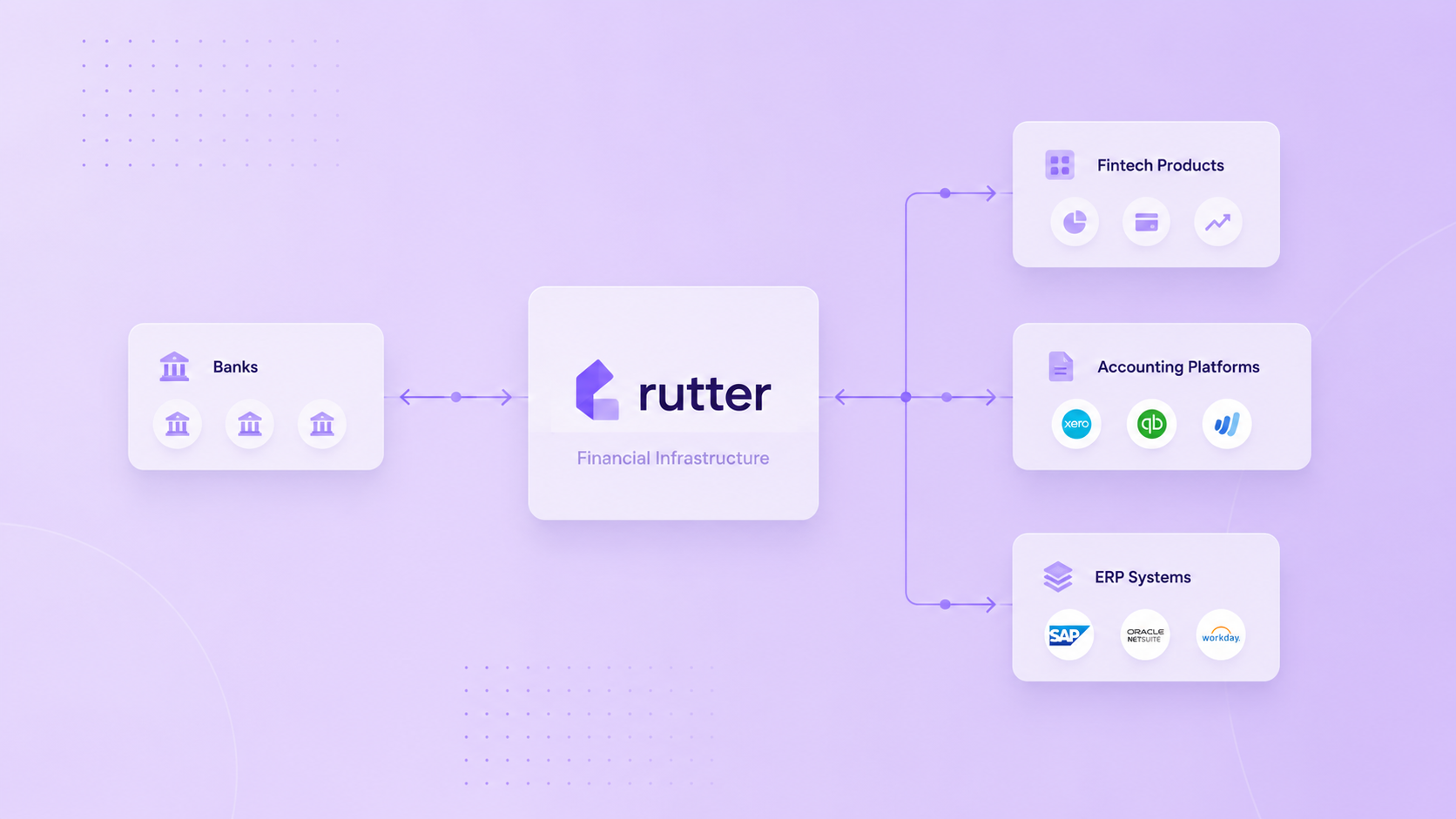
Those actions require access to systems of record. Accounting software, ERPs, commerce platforms, payment processors, and banking systems hold the data that financial agents need. Without trusted integrations, an AI workflow remains a chat interface sitting outside the work.
Rutter MCP is Rutter’s emerging Model Context Protocol layer for finance. It exposes Rutter’s unified read/write access to ERP, accounting, commerce, and payments platforms through a protocol designed for AI agents and LLM-powered workflows. In simple terms: Rutter MCP helps financial AI agents connect to the systems where financial work actually happens.
Financial AI agents are AI-powered workflows that can reason over financial tasks and take structured actions. They may assist with AP, AR, reconciliation, underwriting, cash flow, forecasting, tax, expense management, reporting, or support operations.
Examples include:
The common requirement is access. A financial agent has to read reliable data and, in some workflows, write safely back to systems of record.
Model Context Protocol, or MCP, is a way for AI applications to access external tools and data sources through a standardized interface. For finance, MCP becomes useful when it connects agents to systems like NetSuite, QuickBooks, Xero, Sage Intacct, Shopify, Stripe, PayPal, and other systems that contain business financial data.
Rutter MCP applies the same integration logic behind Rutter’s Accounting API, Commerce API, and Payments API to AI-native workflows. Instead of every AI product building its own ERP and accounting integrations, an agent can use Rutter’s unified access layer.
That matters because financial AI is not useful if it can only describe the work. It has to connect to the work.
Financial workflows are grounded in systems of record. A model can generate a plausible answer, but a financial product needs the actual bill, invoice, account, vendor, subsidiary, transaction, payout, journal entry, or order. It also needs permissions, auditability, and safe write behavior.
For example, an AP agent might identify that a vendor payment is ready for approval. But before it can help, it needs to know:
Those questions cannot be answered from generic model knowledge. They require live system access.
Rutter’s Rutter Link helps with authentication and consent. Rutter’s Unification Layer helps normalize platform differences. Rutter’s Monitoring helps teams track logs, webhooks, sync history, and connection health for production reliability.
Many financial AI tools start as read-only assistants. They summarize dashboards, answer questions, draft emails, or interpret reports. Those use cases can be valuable, but they do not fully automate financial operations.
Action-capable financial agents need read/write access. They might create a draft invoice, update a vendor, post a journal entry, mark a bill payment, reconcile a transaction, or prepare an underwriting package. That raises the bar for infrastructure.
Teams need:
A financial AI agent should not be a black box with admin credentials. It should be an agent operating through governed systems, scoped permissions, and auditable actions.
Rutter’s May product updates describe Rutter Coverage Agents, an internal fleet of AI subagents used to build and test new platform integrations before engineering review. Specialized subagents handle fetch layers, schema mapping, tests, and live verification against real platform sandboxes. Recent bootstrapped platforms included Acumatica, Campfire, DualEntry, Fulfil, Odoo, Exact Online, Lexware, and Visma e-conomic.
This matters for MCP because financial agent usefulness depends on coverage. If agents can only connect to one or two systems, their value is limited. If coverage can expand quickly across accounting, ERP, commerce, and payments platforms, AI workflows can reach more of the systems businesses actually use.
Coverage is not the only requirement, but it is the foundation. No agent can act in a system it cannot access.
Rutter MCP can support several categories of financial AI workflows.
An agent can review bills, check vendor data, detect missing accounting fields, suggest approval routing, and prepare payment records for review.
An agent can compare bank transactions, payment records, invoices, and ledger entries to identify likely matches or exceptions.
An agent can gather accounting, commerce, payment, and cash flow data to prepare a lending file or surface risk signals.
An agent can analyze orders, refunds, inventory, payout patterns, and store performance to support merchant finance products.
An agent can monitor failed syncs, webhook issues, revoked consent, and stale data, then suggest or trigger recovery workflows.
A financial AI agent is an AI-powered workflow that can assist with or execute finance tasks such as AP, reconciliation, underwriting, reporting, expense management, or cash flow operations.
MCP gives AI applications a standardized way to access external tools and data sources. In finance, MCP can connect agents to accounting, ERP, commerce, payments, and banking systems of record.
Financial agents need actual live data, permissions, and write paths to be useful. Without system access, they can only summarize or suggest. With governed access, they can support real workflows.
Rutter MCP exposes Rutter’s unified read/write integrations through an AI-native protocol, helping agents access accounting, ERP, commerce, and payments systems without every team building custom integrations.
Financial AI agents will not be judged by how fluent they sound. They will be judged by whether they can safely help finance teams get work done. That requires access to systems of record, normalized data, clear permissions, safe writes, auditability, and production observability.
Rutter MCP brings the integration layer to AI workflows. It gives agents a path from conversation to action across the financial systems businesses already rely on. As financial products become more agentic, connectivity becomes the difference between a useful assistant and a real operating layer.

Building integrated products is hard. We can do that together. Let's chat.
.png)
.png)