.png)
Industry
Remittance Advice: The Missing Link Between Payment and Reconciliation
Learn what remittance advice contains, how it differs from a payment confirmation, and why structured data improves invoice matching.



One thing that surprised me when we started deploying Agentic Commerce into production is how often people assume there’s one system involved.
There isn’t.
In almost every real merchant environment, agentic commerce is not a single integration problem — it’s a systems problem. Multiple systems, each doing a narrow job, each believing it is the source of truth for something important, and none of them designed with autonomous agents in mind.
If you don’t understand how these systems interact, you’ll end up with an agent that looks smart in a demo and breaks down the second it tries to place a real order.

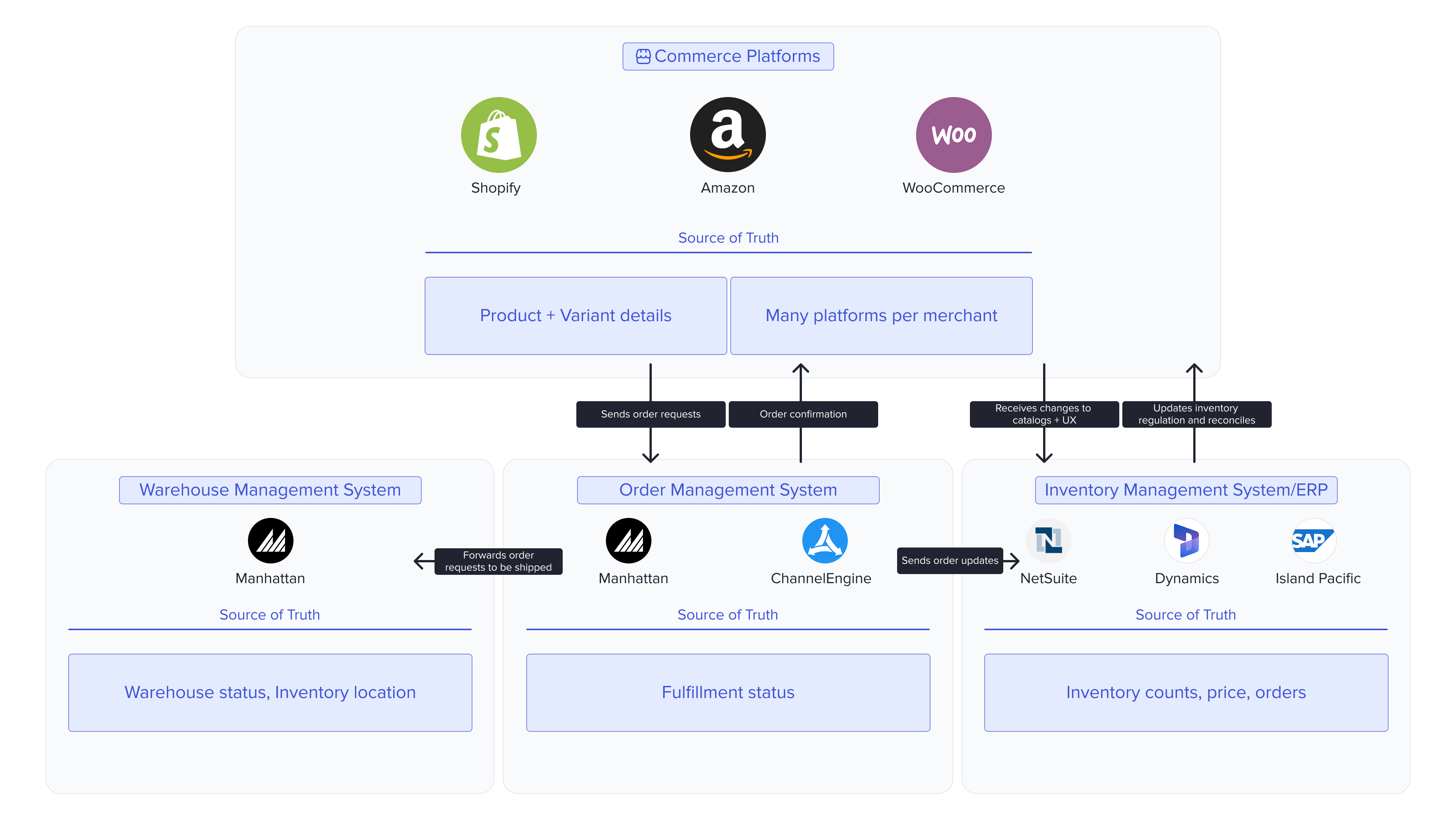
This is the consumer-facing surface area.
Shopify, Amazon, WooCommerce, BigCommerce — this is where product variants live, images are hosted, descriptions are written, and UX decisions are made. For SMBs, this is often the system. For larger merchants, it’s just one of many.
From an agent’s perspective, this system answers questions like:
It is not the financial source of truth, no matter how much merchants wish it were.
IMS/ERPs are considered the financial backbone of the business.
NetSuite, Dynamics, SAP, Island Pacific — this is where inventory counts, pricing logic, cost accounting, and financial reconciliation live. This system does not care about UX. It cares about being right.
For Agentic Commerce, this system answers:
If your agent places an order without consulting the ERP, you’re playing roulette with reality.
The OMS is the router.
Systems like Manhattan or ChannelEngine sit in the middle, coordinating inventory and orders across multiple channels. They help merchants avoid overselling and route fulfillment correctly — but crucially, they are not systems of record.
The OMS exists to keep other systems from lying to each other.
Agents don’t reason in the OMS — they reason through it.
WMSs care about one thing: moving atoms.
They know where inventory physically sits, what’s been picked, packed, and shipped. For most Agentic Commerce use cases, this system is downstream and rarely directly touched — but it’s still part of the truth chain.
Agentic Commerce doesn’t require “everything.” It requires very specific workflows to be correct.
Agents need rich, structured product data to reason properly.
This isn’t just name and price — it’s variants, dimensions, materials, compatibility, constraints. Garbage in, garbage out. If your product catalog is thin, your agent will hallucinate confidence.
Before an agent can sell something, it needs to answer three brutal questions:
1. Do we have it?
2. Can we ship it to this person?
3. Is this transaction compliant?
Inventory counts often live in the ERP. Locations matter. Shipping logic might be split across systems. Tax rules vary by jurisdiction. This is where most “agentic” demos quietly stop.
Once an order is placed, it needs to land somewhere real.
Orders must be logged, reconciled, fulfilled, and tied back to customers. Loyalty, personalization, refunds — all of that requires that the merchant retains the customer relationship.
An agent that places orders but doesn’t preserve customer identity is just a very fast disintermediator.
Here’s the part most people miss: the system of record shifts as merchants scale.
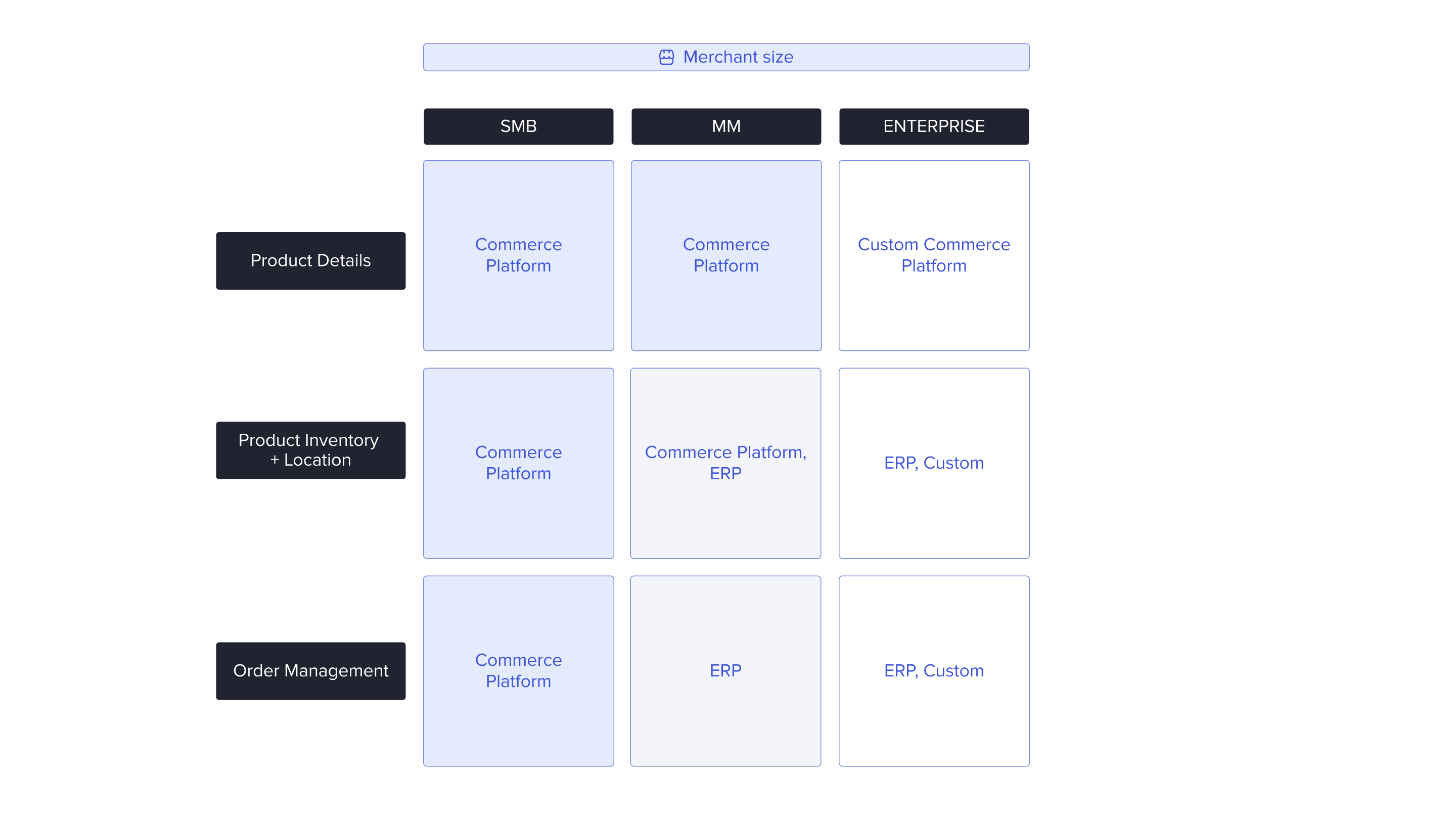
Everything lives in the commerce platform.
Product data, inventory, orders — Shopify is the brain. This is why SMB Agentic Commerce looks deceptively easy.
The center of gravity moves.
The ERP becomes the hub. Commerce platforms become spokes. Inventory and pricing live centrally, while multiple sales channels compete for stock. This is where OMS usage explodes.
There is no single truth — only negotiated truth.
ERP plus custom tooling plus legacy systems plus business-specific logic that no vendor fully understands. Agentic Commerce here is less about automation and more about constraint satisfaction.
If your architecture assumes “one stack,” it will fail the moment you move up-market.
Rutter exists because none of this complexity goes away just because you introduce an agent.
Agents don’t eliminate integrations — they stress them.
Rutter provides a unified API across commerce platforms, ERPs, and supporting systems so agents can:
The point isn’t abstraction for abstraction’s sake. The point is making agentic workflows deterministic across merchant sizes and system topologies.
If you’re building Agentic Commerce and you’re only integrated with a single platform, you’re not done — you’re just early.
If you want to ship agents that actually transact in the real world, you need to understand the systems they operate inside.

Building integrated products is hard. We can do that together. Let's chat.
.png)
.png)