.png)
Industry
Remittance Advice: The Missing Link Between Payment and Reconciliation
Learn what remittance advice contains, how it differs from a payment confirmation, and why structured data improves invoice matching.



So you're a payment company or LLM provider looking to offer Agentic Commerce capabilities to your merchants. Maybe you want to enable AI-powered checkout experiences, maybe you're building autonomous shopping assistants, or maybe you're just trying to stay ahead of where the industry is moving.
Either way, you're about to learn what every platform building in this space discovers: the AI is the easy part. The commerce integrations will destroy your roadmap.
Let me show you why, and more importantly, how to actually ship this without your engineering team staging a revolt.

Let's say you're enabling Agentic Commerce for merchants across your payment platform. Your merchants sell on Shopify, Amazon, WooCommerce, BigCommerce, and a dozen other platforms. For your Agentic Commerce feature to work, you need:
Product Discovery:
Transaction Execution:
Post-Purchase:
Now multiply this by 10, 20, or 50 different commerce platforms. Each with its own API structure, authentication flow, rate limits, and quirks.
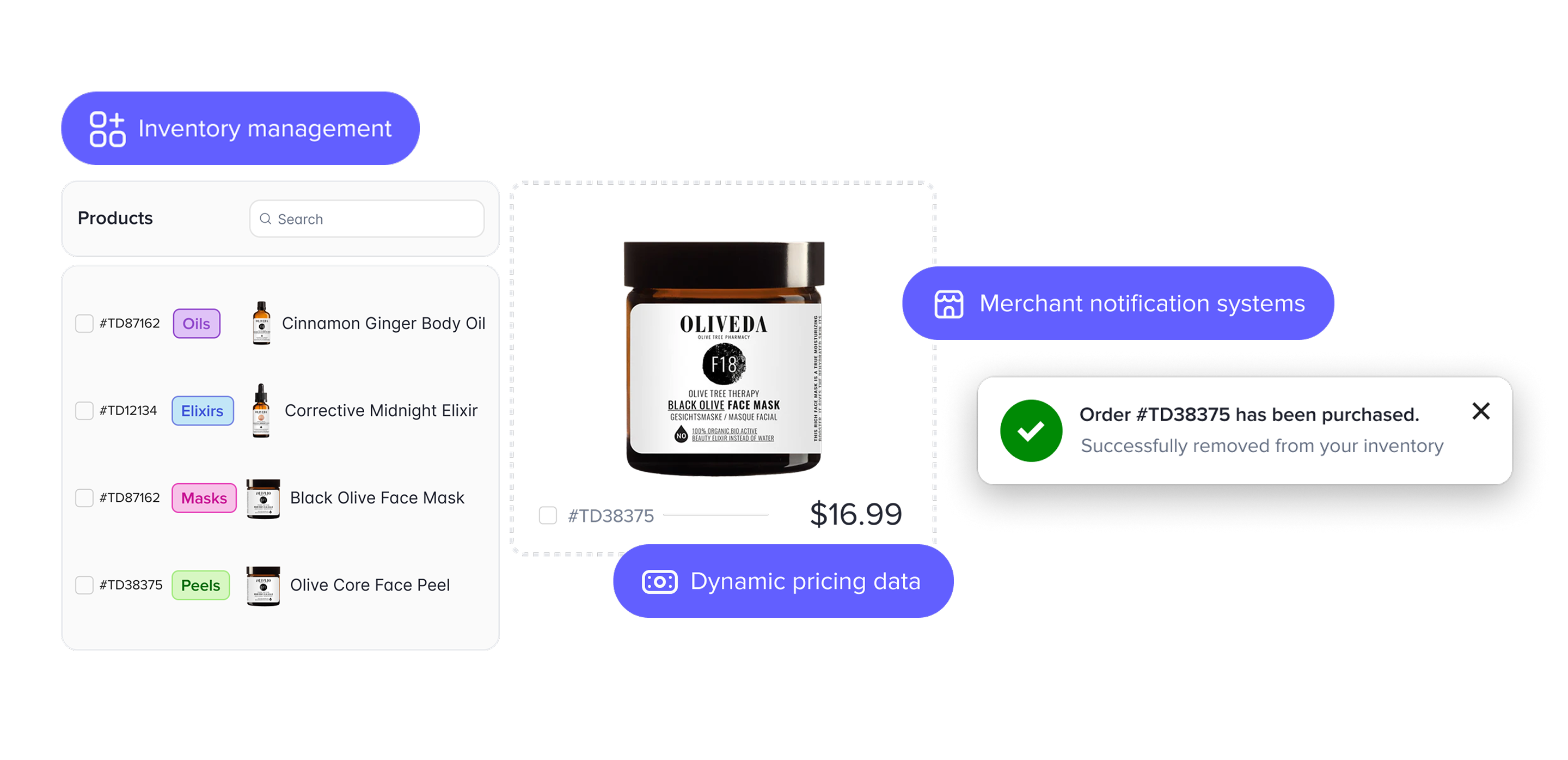
Here's where most payment companies and LLM providers make a critical mistake: they start building direct integrations to each commerce platform.
Month 1: Shopify integration works great. Your team is confident.
Month 4: Amazon integration is fighting you every step. The data models are completely different.
Month 7: WooCommerce is done, but Shopify just deprecated the API version you built against.
Month 10: Your engineering backlog is 60% "maintain existing integrations."
Month 12: A key merchant asks for BigCommerce support.
This isn't sustainable; and it gets exponentially worse when you realize that different platforms structure their data completely differently. A "product" in Shopify looks nothing like a "product" in Amazon. Inventory tracking works differently across every platform. Order objects have entirely different schemas.
A unified commerce API solves this by providing a single, standardized interface across all commerce platforms your merchants use. Instead of building and maintaining 20+ integrations, you build one.
Here's what a product query looks like with Rutter:

That same call works whether your merchant's store is on Shopify, WooCommerce, BigCommerce, Amazon, or any other platform we support. The data structure is identical. Your AI agent doesn't need to know or care which platform it's talking to.
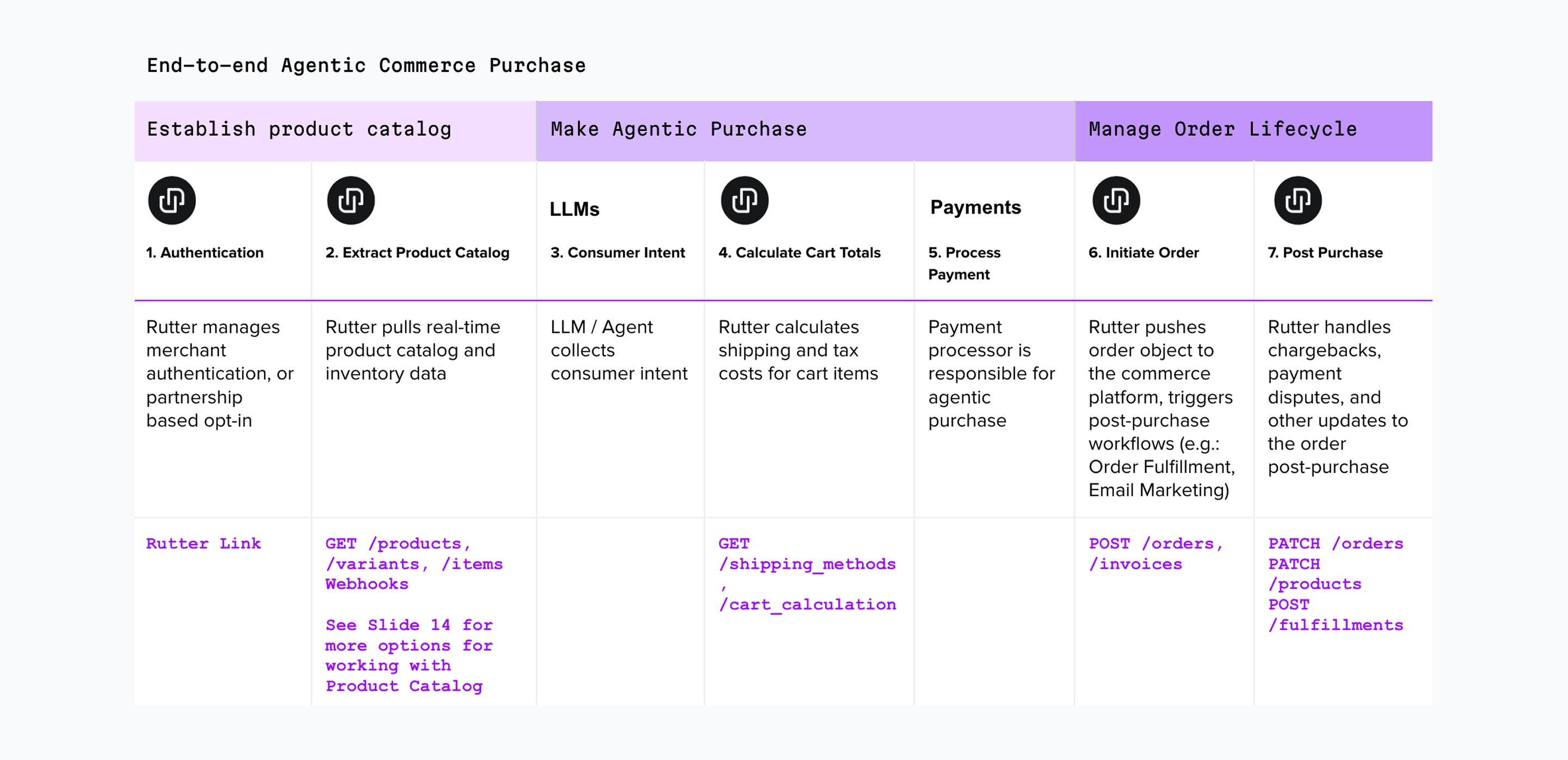
Let's walk through a practical example. You're a payment processor enabling Agentic Commerce capabilities that help your merchants' customers automatically reorder frequently purchased items.
Connect your merchant's commerce platforms through Rutter Link (our OAuth flow). Merchants authorize once, you get unified access to their product catalogs, inventory, and order systems across all their sales channels.
Use Rutter's unified API to access product data across all the merchant's platforms:

Your LLM or AI agent analyzes customer behavior, processes natural language requests, considers inventory availability, and determines optimal purchasing decisions.
Execute transactions on behalf of customers through the unified API:

Commerce platforms have strict and varying rate limits. Shopify allows 2 requests/second for standard plans, 40 requests/second for Plus. Amazon has complex throttling logic. WooCommerce depends entirely on hosting infrastructure. Unified APIs handle this complexity for you, intelligently queuing requests, managing retries, and optimizing batch operations across different platforms simultaneously.
Instead of setting up and maintaining webhooks with each individual platform your merchants use, you get standardized webhooks from the unified API. One endpoint to monitor, consistent data format, unified event types.

When an order fails (payment declined, out of stock, platform temporarily unavailable), you get standardized error codes instead of parsing dozens of platform-specific error messages.
Agentic Commerce needs to be fast. End customers expect AI assistants to complete purchases in seconds, not minutes. Your merchants expect this to work flawlessly at scale.
Key optimization strategies:
You're enabling systems that will spend real money on behalf of real customers for real merchants. Security and compliance aren't optional—they're table stakes.
Essential security practices:
Ready to enable Agentic Commerce for your merchants?
Here's your path to production:
By the end of week 2, you'll have a working Agentic Commerce capability ready for merchant beta testing. From there, it's about refining the AI experience and expanding merchant adoption.
Enabling Agentic Commerce for your merchants doesn't have to be an 18-month integration nightmare. With the right infrastructure, a unified commerce API, you can focus on what actually differentiates your platform: creating AI experiences that drive revenue for your merchants.
The commerce integration layer should be boring, reliable, and invisible. That's the goal. Build once, support every merchant platform your customers use.
Your merchants need Agentic Commerce capabilities. Your competitors are building them. The question isn't whether to offer this—it's how fast you can ship it.
Now go enable something transformative for your merchants. Talk to our team today.

Building integrated products is hard. We can do that together. Let's chat.
.png)
.png)